 The Calm Malinois

It's 7 PM. Your Malinois has had a long walk, dinner and plenty of play, and now he's racing laps around the couch, grabbing sleeves and bouncing off the walls. Sound familiar?
Malinois don't come with an off switch. You build one, a few minutes a day, by rewarding calm as seriously as you reward action. Here's how.
Why Malinois get the zoomies
- They're overtired. An overtired Malinois gets wilder, not sleepier. This is the number one cause of evening chaos.
- The brain didn't get enough work. A body that ran for an hour but a brain that did nothing still needs an outlet.
- They never learned how to relax. Settling down is a skill. Many Malinois simply haven't been taught it yet.
Short, happy bursts of zoomies after a bath or a good poop are normal for any dog. What we're talking about here is the frantic, can't-stop energy that turns into biting and barking.
Why more exercise isn't the answer
The most common advice is "run him more." With a Malinois, that often builds a fitter dog who needs even more exercise, while he still has no idea how to rest. Exercise matters, but it's only one of three daily needs: something for the body, something for the brain, and real rest.
See how much exercise a Malinois really needs for the full breakdown.
1. Protect sleep
Puppies need about 18 to 20 hours of sleep a day. Adult dogs usually need 12 to 14. Many Malinois won't take those naps on their own, especially when the house is busy.
If your dog gets wilder in the evening, plan more naps, not more exercise. A crate or a quiet room with a chew makes naps happen. Make the crate feel like a bedroom, never a jail: feed meals in it, toss treats in, and build up to closed-door naps with a frozen lick toy.
2. Give the brain a job
Aim for 15 to 30 minutes of brain work a day, in short pieces:
- Feed at least one meal from a puzzle feeder or snuffle mat, or scatter it in the grass.
- Play "Find it": hide treats around the house and let your dog search.
- Do two or three 5-minute training sessions.
- Offer licking and chewing. Both help dogs relax.
3. Capture calm
This one takes no training sessions at all. Keep a small jar of treats in each room. Whenever your dog lies down and relaxes on their own, walk over and quietly place a treat between their paws. No excited voice. Over a couple of weeks, your dog learns that lying down calmly makes good things happen, and you'll see them choose it more often.
4. Teach a "Place" mat
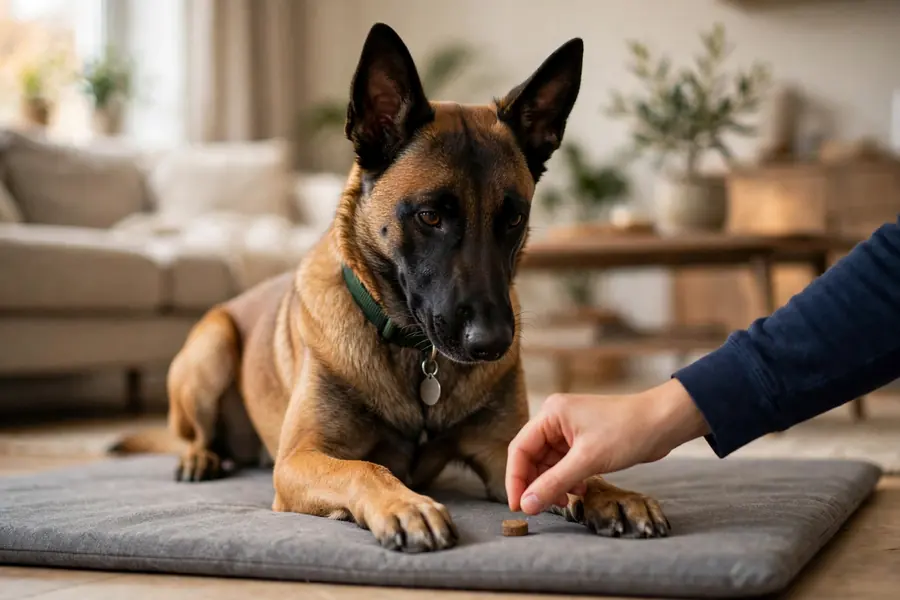
- Lure your dog onto a mat. When all four paws are on, say "Yes!" and reward on the mat.
- Toss a treat off the mat to reset, then wait for your dog to step back on.
- When your dog goes to the mat on their own, add the cue "Place."
- Ask for a down, and deliver treats between the paws every few seconds.
- Slowly space out the treats. Release with "Free."
Build toward 20 to 30 minutes with a chew. Use the mat during dinner, TV time and when guests arrive.
Build the off switch, day by day
From Maligator to Best Friend has an Up-and-Down coach, a nap planner and a training card for every day of 90, so calm becomes a habit, not a lucky evening.
See the guideInstant access on any phone or computer. 30-day money-back guarantee.
5. Play the Up-and-Down Game
This is the real off switch: practicing the change from excited to calm and back again.
- Play tug for about 10 seconds with "Get it!"
- Say "Out" and wait for the release.
- Ask for a sit or down. Wait until you see calm: slower breathing, a softer body.
- The moment you see calm, restart the game with "Get it!"
- Repeat 3 to 5 rounds, then end with calm time on the mat.
Your dog learns that calming down is what turns the fun back on. Over time, the switch from wild to calm gets faster.
What to do during a zoomie meltdown
- Don't chase. To a Malinois, that's the best game ever.
- Stay slow and quiet. Fast movements and loud voices raise excitement.
- Calmly lead your dog to the crate or mat with a chew or lick mat.
- Next time, look at what happened in the hours before: a missed nap is the usual suspect.
Signs it's working
- Your dog goes to the mat on their own.
- Your dog settles within a few minutes after play.
- Evening zoomies get shorter and less frequent.
- Your dog can watch the world without barking or lunging.
Free: the Maligator Survival Kit
A 3-day biting reset, a printable daily schedule for puppies and adults, and a family cue card for the fridge. It opens right away.
You will also get a few training tips by email. Unsubscribe anytime. Privacy